16/09/2026 – ITMA 2027 — auf Deutsch lesen
From machines to connected systems
Sewing remains labour-intensive, but almost everything around it is being automated and digitally linked at scale. Connected transport, cutting, machine vision and MES increasingly coordinate thousands of machines and operators as one system.
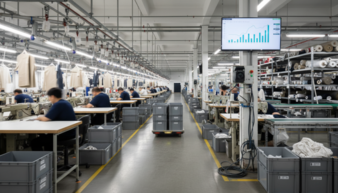
Connected garment production: despite growing automation, sewing remains a central, human-led operation. © Meisenbach Verlag - generiert mit KI
Where intelligence enters the factory
Walk into a large apparel factory and the contrast is immediate. Autonomous vehicles and intelligent transport move materials, automated warehouses feed spreading equipment, machine vision checks quality, and production planning can be AI-driven. Then you reach the sewing lines and see the familiar scene: operators guiding fabric through needles.
The reason is the material itself. Fabrics stretch, wrinkle and distort, and their behaviour changes with construction, weight and finish. Humans compensate instinctively; robots still struggle. Industry studies cited in the source indicate that sewing typically accounts for 30–50% of the workforce in vertically integrated garment factories, depending on product complexity. Rather than replacing sewing operators, manufacturers have spent the past two decades automating many surrounding tasks.
A factory producing 8–12 million T-shirts a year may run 600 to 1,000 sewing machines. The largest manufacturers expand in campus-style phases, installing 2,000–4,000 machines in a single step. At that scale, flow becomes an engineering challenge: fabric rolls are identified by barcode or RFID, stored in automated warehouses and delivered to spreading equipment as required. Computer-controlled spreading regulates tension; CNC knife or laser cutters produce nested pattern pieces. Automatic cutting systems are described as routinely achieving 80–90% fabric utilisation, while integrated vision can identify defects before cutting begins.
Unit production systems add a digital identity to every garment. Pieces travel on overhead carriers that record order data, size, colour, production stage, operator history and quality data, then route automatically to the next available operator with the required skills. Eton Systems reports a shirt-production example where throughput time fell from 14 days to less than one day, while output doubled.
The description draws on an ITMA Insights blog post published on 24 August 2026, presenting ITMA 2027 as a place for manufacturers to compare solutions across the textile and garment manufacturing value chain.