27/08/2026 – CottonBee — auf Deutsch lesen
Color differences in textile printing
Designs are usually created in RGB on screen, but colour on fabric is built with inks or dyes that react differently depending on fibre type, surface and finish. Factoring that in early lowers the risk of disappointment at the sampling stage or during the first production run.
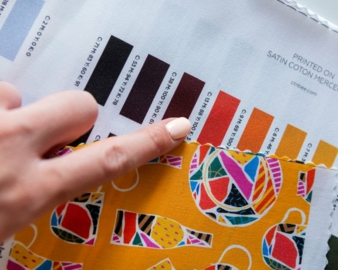
The final colour result depends strongly on the properties of the fabric that is being printed on. © Cottonbee
Transferring a digital design to a finished fabric is one of the greatest challenges in textile product development. One reason lies in the colour differences that emerge during the process: many patterns are created on screen in the RGB model. This light-based system can display a wide range of intense, highly saturated colours. In textile printing, colour is created on a physical material using inks or dyes. That is why not every shade seen on a monitor can be reproduced with full accuracy. Differences are especially noticeable in intense blues and greens, neon shades, and highly saturated colours.
Fabric influences colour outcome
The final colour result depends strongly on the properties of the fabric that is being printed on. Depending on fibre type, surface, whiteness, smoothness and finish, the same design can look different on cotton than it does on polyester satin. While colours on cotton often appear more natural, softer and more matte, they tend to look more contrasting and defined on smooth synthetic fabrics, especially those with a slight sheen. Colour should therefore be assessed on the actual fabric intended for production. A screen helps to evaluate the design, but it does not fully show how colour will behave on the finished material.
Printing technology shapes fabric feel
The chosen printing technology also matters. Each process builds colour differently and interacts with the substrate in its own way. For natural fibres, pigment printing and reactive printing are often compared: both can deliver very good results, but they differ in process, colour fixation, fabric feel, and how the design behaves on the material.
In the end, the finished product is what counts: how it looks, how it feels, and what quality it offers. Colour is created through the interaction of technology, material, light, finishing and the way the fabric is evaluated. A well-managed process is based on conscious planning, testing and decisions made
About CottonBee
CottonBee is a fabric and knitwear printing company from Poland, specialising in digital textile printing for brands, designers, and individual customers. The CottonBee team supports clients in selecting materials, printing technologies, and working with colour throughout the production process.
https://ctnbee.com/en