03/11/2026 – Kraków label LIGAS — auf Deutsch lesen
Small runs, big minimums
For a small brand, the cheapest price per piece is not always the cheapest way to produce. Brandon Robinson, founder of the Kraków label Ligas, explains why his yoga and pilates wear is sewn in Poland, and where the real costs sit.
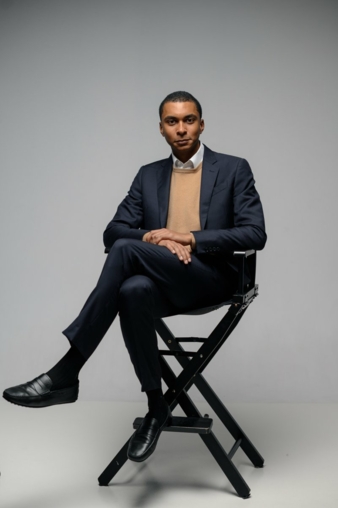
Brandon Robinson founded Ligas, a Kraków label of women's yoga and pilates wear, in 2023. Before that he worked as an accountant and in insurance in Luxembourg. LIGAS is sewn in Poland using fabric from Spain. © Urszula Opitek
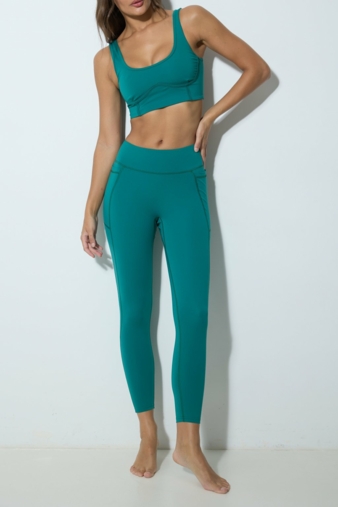
Ligas Yogawear: Romy Collection. © Urszula Opitek
What sewing in Poland instead of Asia really costs a young activewear label
When I started LIGAS in 2023, almost every piece of advice pointed the same way: produce in Asia. Sewing there is significantly cheaper per piece, and that part of the advice is correct. What it leaves out is how much a small brand has to commit before the first piece is sold. Three years on, our collection is sewn in Poland, mainly at a workshop in Krosno, in south-eastern Poland, that has been producing since 1989. Our fabric comes from Spain. Here is the calculation behind that decision, as it looks for a label of our size.
Minimum orders matter more than unit price
In Poland, workshops typically accept 10 to 20 pieces per size. That lets us produce a new style in a small run, see how it sells, and reorder only what customers actually buy. A larger minimum would turn every new style into a bet, with the money tied up in stock until it sells. For a young brand, cash tied up in unsold inventory is often a bigger risk than a higher unit cost. A lower price per piece only helps if you can sell everything you were required to make.
Fabric is the real bottleneck
The sewing minimum is only half the story. The bigger constraint for us has been fabric. This autumn we asked around 260 mills worldwide for samples and quotes, and the numbers show where the trade-off sits. Quotes we received from Asian mills ranged from about €2.40 to €7.00 per metre, with a minimum order of 3,000 metres. European quotes were around €10 to €11 per metre, starting from 350 metres per colour. Per metre, Asia is far cheaper. But the minimum order changes the picture. At the lowest Asian price, 3,000 metres means a commitment of about €7,200. At the highest, about €21,000. A European run of 350 metres in one colour comes to roughly €3,500 to €3,850. Even at the cheapest Asian price, the entry ticket is about twice that of a single European colour, and it locks a small brand into one fabric for a long time.
Quality has to be tested, not assumed
Price is not the only filter. Our leggings and sports bras need a fabric that holds its shape, stays opaque in a deep squat and feels good during a long class. So far, we have not found an Asian fabric that meets our requirements. Our primary supplier for leggings and sports bras is SPW in Spain, and we are sampling with other Spanish producers, such as Oktex in Barcelona.
We took this seriously enough to spend 2025 rebuilding the collection with a new designer and testing the product extensively before relaunching it. That kind of iteration is much easier when the workshop is a few hours' drive away and small runs are possible. A fit correction can go into the next batch rather than waiting for the next season.
What it means for pricing and sales
Producing in Europe shows up in the retail price. Our leggings sell for €89.99. We sell around 70 per cent online and 30 per cent through stockists, currently eight, including the Restart Pilates studios in Manchester. In October 2026 we sold more than 2,000 pieces. Small batches let us restock the colours and sizes that sell.
The trade-offs
This model is not free of costs. Our unit cost is higher than it would be in Asia, small workshops have limited capacity, and depending on a few partners carries its own risk. If our volumes grow by an order of magnitude, the calculation will change, which is why we keep sampling widely, including from Asian mills.
For now, the lesson for other small brands is simple. Before comparing prices per piece, compare the total commitment: sewing minimums, fabric minimums, and the cash that sits in stock until it sells. For a brand that is still learning what its customers want, the ability to make 10 pieces per size can be worth more than a lower unit price.
About the author
Brandon Robinson founded Ligas, a Kraków label of women's yoga and pilates wear, in 2023. Before that he worked as an accountant and in insurance in Luxembourg. Ligas is sewn in Poland using fabric from Spain.