23/06/2026 – Cotton — auf Deutsch lesen
Bremen Cotton Exchange confirms Fritz A. Grobien as President
At its 152nd General Assembly on 18 June 2026, the Bremen Cotton Exchange re-elected Bremen merchant Fritz A. Grobien as President and confirmed its Vice-Presidents. A keynote by Sparkasse Bremen CEO Dr Tim Nesemann highlighted tariffs, disrupted supply chains and rising financing costs as key risks for industry.
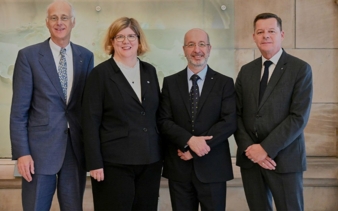
Executive Committee of the Bremen Cotton Exchange: President Fritz A. Grobien and Vice-Presidents Stephanie Silber, Jean-Paul Haessig and Jens D. Lukaczik (from left to right) © Bremer Baumwollbörse
Continuity and textile expertise on the Board
The 152nd Ordinary General Assembly met in Bremen and approved the financial statements, accepted the annual report for the 2025 business year and unanimously discharged the Board and management. With the re-election of Fritz A. Grobien as President and the renewed mandates for Vice-Presidents Jean-Paul Haessig, Jens D. Lukaczik and Stephanie Silber, the existing leadership structure remains in place.
After his re-election, Grobien emphasised that the Bremen Cotton Exchange has for generations stood for independent cotton quality assessment, international networking and the out-of-court settlement of trade disputes. In his view, this makes the organisation a reliable point of reference for the global cotton sector and underlines the need for cotton to maintain a strong presence in the market. He also highlighted Bremen as a place where knowledge, market understanding and international cooperation in the cotton business come together.
The newly confirmed Board includes representatives from Getzner Textil, Velener Textil, CWC Textil, Hch. Kettelhack, Gebr. Elmer & Zweifel, Cotton Service International, the Gesamtverband der deutschen Textil- und Modeindustrie and the Vereinigung Textilindustrie in Vienna. According to the Cotton Exchange, this voluntary body brings together companies from all stages of the cotton supply chain, from trade and processing to specialised service providers, and gives the association broad textile competence.
Macroeconomic headwinds for cotton and textiles
Guest speaker Dr Tim Nesemann, CEO of Sparkasse Bremen, provided the economic backdrop. He described how tariffs, disrupted supply chains and rising financing costs are weighing on companies, alongside continued economic weakness in Germany and growing pressure on Europe's industrial base.
Nesemann pointed to increasing risks for banks and more complex restructuring processes due to regulation. He also warned of cybercrime, attacks on critical infrastructure and new dependencies arising from digitalisation and artificial intelligence. While he sees opportunities in trade agreements such as Mercosur, he cautioned against political polarisation and the rise of radical forces in Europe.
His conclusion: companies, policymakers and society can emerge stronger from crises if they recognise change early, take responsibility and actively seize opportunities.