25/08/2026 – 23. SupplyX-Barometer — auf Deutsch lesen
Resilience Starts with Suppliers
SupplyX surveyed 150 logistics managers in Germany on the topic “Rethinking Supply Chains – Perspectives, Challenges, and Responsibility.”
© SupplyX
© SupplyX
The 23rd SupplyX Barometer is based on a telephone survey of 150 logistics managers in Germany (survey period: March 2026) and examines the theme “Rethinking Supply Chains – Perspectives, Challenges, and Responsibility.” It finds that supply chains are increasingly judged by how efficient, resilient, flexible, and adaptable they are.
Rising expectations
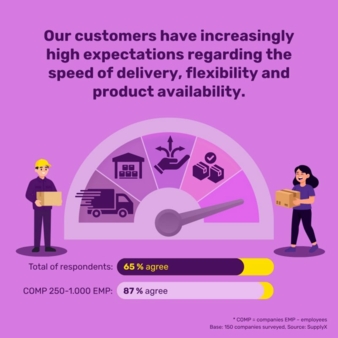
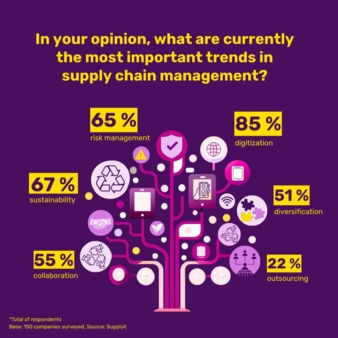
Digitization remains the top trend: 85% of respondents rate it as the most important development in supply chain management, but many companies still struggle with implementation. Expectations are rising: 81% report growing customer demands for delivery speed, flexibility, and product availability, and 68% see a stronger need for information across the entire supply chain. However, only 33% say they have the comprehensive real-time data required for end-to-end control. Key barriers include regulatory requirements (59%), high investment costs (56%), cyber risks (47%), and a shortage of skilled workers (46%).
Importance of stable supplier relationships
Beyond digitization, sustainability (67%) and risk management (65%) are gaining importance. Companies also focus on closer collaboration (55%) and diversification (51%) to build broader, more interconnected supply chains. The strongest lever for resilience is stable supplier relationships, cited by 90% of respondents.
Data remains crucial, with 70% emphasizing intelligent data use and 66% relying on monitoring and analyzing goods movements.
For optimization, digital collaboration with partners and customers ranks highest at 75%, and 65% consider end-to-end connectivity indispensable (rising to 87% among companies with 250–1,000 employees). SupplyX CEO Henning Goldmann argues that technology creates the most value when it connects partners, and he highlights a shift toward assigning more responsibility to specialized logistics partners who actively manage and develop supply chain processes.