29/07/2026 – Advertisement — auf Deutsch lesen
Prevent sweating instead of managing it
Why moisture transport alone acts too late
Rising temperatures, the shift between warm outdoor environments and air-conditioned indoor spaces, and increasing comfort expectations are changing the demands on textiles. Moisture transport alone falls short. What is needed are solutions that act earlier – before heat builds up and comfort suffers.
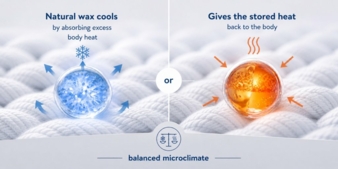
Outlast technology with microencapsulated natural wax buffers temperature peaks in the textile microclimate and helps to reduce overheating and sweat formation. © Outlast Technologies GmbH – generiert mit KI

Instead of merely managing sweat, Outlast® can help reduce the build-up of excess heat and therefore address the trigger of thermal discomfort. © Outlast Technologies GmbH – generiert mit KI
New times call for new textile answers
Rising temperatures, the shift between warm outdoor environments and air-conditioned indoor spaces, and increasing comfort expectations are changing the demands on textiles. Today, comfort is no longer defined by soft materials or classic moisture transport alone. What is needed are solutions that actively support the body under dynamic conditions.
However, many performance textiles still only come into play once the problem has already occurred: moisture-wicking materials transport sweat away from the skin and can help reduce a feeling of dampness. But they only react after heat has already built up and the body has started to sweat. In times of changing climate conditions, this purely reactive approach is no longer up to date.
The key question is therefore: How can textiles help reduce overheating – ideally before heavy sweating even starts?
This is where Outlast® Temperature Regulation comes in. The technology supports a more balanced microclimate between skin and textile by absorbing excess heat, storing it, and releasing it again as temperatures drop. This helps buffer temperature peaks and stabilize the wearing comfort.
The difference lies in the approach: Instead of merely managing sweat, Outlast® can help reduce the build-up of excess heat and therefore address the trigger of thermal discomfort. This makes the technology particularly interesting for applications where people are exposed to changing temperatures, physical activity, or long wearing times.
Independent tests show that this proactive approach can reduce moisture build-up by up to 24 percent in apparel and even by up to 48 percent in bedding compared to conventional materials.
For brands and manufacturers, this creates a clear opportunity: They can communicate comfort not just as a short-term freshness promise, but as reliable, measurable performance. Modern textiles need to do more than transport moisture away. They need to help regulate thermal comfort more intelligently – in line with new climate conditions and rising consumer expectations.