11/02/2026 – RWTH Aachen — auf Deutsch lesen
Award for Sustainable Carbon Fibre Cycles
Targeted electrochemical surface modification can make carbon fibre sizing resistant to solvolysis. This approach, developed by Sabina Dann, earned her the MSW Award from RWTH Aachen University for her master's thesis.
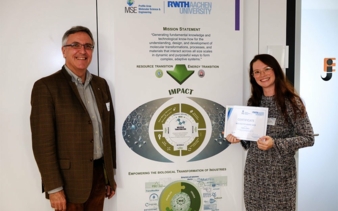
ITA Institute Director Professor Dr Thomas Gries and Sabina Dann with the MSE certificate. © Institut für Textiltechnik der RWTH Aachen
Recovering carbon fibres in a way that maintains their performance remains a key topic for the composite materials industry. In her thesis, Sabina Dann demonstrates how electrochemical surface modification can stabilise fibre sizing during solvolysis. This enables fibres to be reused in higher-value applications rather than being downcycled.
Industry and environmental benefits
If the sizing remains stable throughout the process, fibres can be recovered with fewer property losses. According to the findings, this supports higher-quality recycling and reduces both material and disposal costs. The environmental contribution lies in lower landfill volumes and the conservation of resources through longer fibre life cycles.
Research carried out in international collaboration
Most of the research work for the thesis was conducted within the carbon fibre research group at the Institute for Frontier Materials, Deakin University in Melbourne, Australia. This setting provided access to established carbon fibre expertise and strengthened collaboration between the institutions. RWTH Aachen University recognised the results with the MSW Award in the field of Molecular Science and Engineering, which honours outstanding master's theses with interdisciplinary focus and scientific innovation potential.
Contribution to ITA's research environment
The Institut fur Textiltechnik of RWTH Aachen University is the core of the ITA Group International Centre for Sustainable Textiles. The group's work focuses on the holistic biotransformation of textile technology and the use of biological principles. Sabina Dann's thesis aligns with this direction by presenting a new approach for producing durable, solvent-resistant carbon fibre surfaces that support more sustainable material use.