07/10/2025 – Advertisement — auf Deutsch lesen
Fibers that stay in the fabric
Fibers break loose in the wash and leave the household with the wastewater. Livinguard Better Fresh works at the fiber surface: up to 80% less microfiber release than the same fabric untreated – depending on fiber and fabric type. Tested to ISO 4484-1 and DIN SPEC 4872. Applied during finishing.
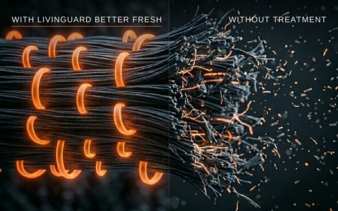
Without treatment, fiber fragments break loose from the fabric during washing. With Livinguard Better Fresh, polymers wrap around the fiber and hold it in place. © Livinguard Technologies
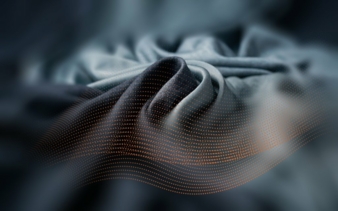
A visualization of the positive charge permanently bonded to the fiber: the functionality is integrated at the fiber surface, without forming a separate film or coating. © Livinguard Technologies
Synthetic and blended fabrics have made performance apparel lighter and more affordable. However, they brought two problems with them: body odor that stays in the textile, and fibers that break loose in the wash and leave the household with the wastewater.
Livinguard Better Fresh works at the fiber surface. A proprietary blend of cationic polymers is permanently bonded to the fiber and gives it a lasting positive charge. Polymers of different lengths wrap around the fibers and hold them in place, so fewer fiber fragments break loose during washing. The mode of action is physical, not biocidal: no registered biocides, no metals such as silver, zinc or copper, and nothing that has to leave the textile in order to work.
Livinguard Better Fresh reduces microfiber release during home laundering by up to 80 percent compared with the same fabric without Livinguard Better Fresh, tested under the same protocol – varying with fiber and fabric type. Tested by independent accredited laboratories to ISO 4484-1 and DIN SPEC 4872, with internal testing to AATCC TM 212.
The same surface binds the molecules that cause sweat-related body odor. They are electrostatically attracted and held on the surface; conventional washing removes the residues. Performance against body odor is validated over 30 home laundries, with evidence to 100 (AATCC 135).
The technology is applied during finishing, by padding or exhaust, alongside other finishing steps and across synthetic, cellulosic and blended substrates. It requires no capital expenditure and adds minimal cost per kilogram. Hand-feel and the physical properties of the fabric are unchanged when the technology is applied correctly.
Brands that specify the technology can carry the ingredient mark on treated products, with usage guidelines, an approved claims framework and the test documentation behind it.
Invented and manufactured in Switzerland.