08/09/2026 – Recycled Fiber — auf Deutsch lesen
Uster Recycled Fiber Matrix classifies recycled cotton
Uster’s Recycled Fiber Matrix offers a two-dimensional way to assess mechanically recycled cotton. Based on AFIS 6 measurements, it grades lots A-D to guide processing and end-use decisions.
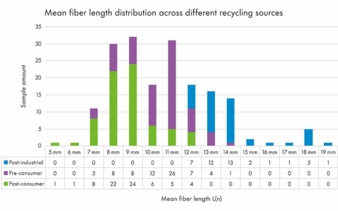
Mean fiber length distribution based on L(n) for different recycling waste types. © Uster Technologies AG
Focus on the fibre, not the label
Mechanically recycled cotton is difficult to categorise because lots can be inconsistent and highly variable. Uster Technologies addresses that challenge with the Recycled Fiber Matrix, designed to support decisions on suitable spinning methods and product end-uses for recycled cotton.
Instead of relying on a single indicator, the approach combines two fibre parameters in one view. Uster’s point is practical: mechanically recycled cotton cannot be classified accurately by a single fibre parameter. Only a combination of two parameters can properly determine processing behaviour and yarn quality.
AFIS 6 data translated into A-D classes
The Matrix is built on measured Uster AFIS 6 values. It focuses on fibre-length characteristics and limiting factors that matter in spinning, including mean fibre length (L(n)), the longest 5% fibre length (5% L(n)) and short fibre content (SFC(n)). Those measurements are translated into clear, colour-coded quality levels from A to D for practical use.
Uster reports that the development work included testing a significant number of 100% mechanically recycled cotton fibre samples from key recycling regions, including China, India and Europe. The sample set covered greige material as well as coloured and bleached recycled fibres. Sources were categorised as post-industrial, pre-consumer or post-consumer waste, and distributed as evenly as possible.
From classification to mill decisions
In industrial application, the quality class can be used to make limitations transparent and to support bale management and machine settings. Uster also links the Matrix to estimating expected short-fibre load and defining suitable blending ratios. Practical recommendations include separating bales by length, source and colour to reduce variability, adjusting draft settings, twist and spinning speed to match fibre quality, and increasing maintenance and cleaning frequency.
Uster describes the Recycled Fiber Matrix as a dynamic, ongoing process, with more samples collected and analysed from global recycling hubs as source materials and processing conditions evolve. An application report with graphs and illustrations is available as a free download at www.uster.com/recycledfibermatrix.