12/05/2026 – Circular nonwovens and new raw materials — auf Deutsch lesen
STFI presents nonwoven advances at Index
From 19 to 22 May 2026, the Sächsisches Textilforschungsinstitut e.V. (STFI) will showcase new developments in nonwovens research at the world's leading nonwovens trade fair Index in Geneva.
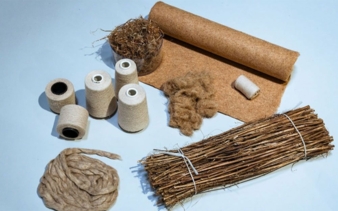
Kendyr has the potential to replace cotton and can be cultivated on soils that have become saline due to long-term cotton cultivation. © STFI/Dirk Hanus
The Centre of Excellence in Nonwovens highlights solutions for the textile circular economy, biobased plastics and alternative fibre plants, with applications ranging from acoustic design elements to safety panels and agricultural nets.
Textile circular economy: nonwovens from chemical recycling residues
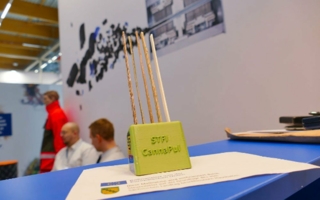
Chemical recycling of mixed textile fractions currently generates residues that are mostly recovered thermally or disposed of. In cooperation with Refresh Global, STFI is investigating efficient processing and treatment routes to bring these residues back into the material loop. The recycled materials are mechanically processed on pilot-scale lines at laboratory or semi-industrial scale, then formed into nonwoven fabrics and consolidated. Through appropriate finishing, a visually suitable top layer can be integrated directly onto the nonwoven. At the stand, STFI will illustrate potential uses with acoustic pictures and a miniature sound box for sound-absorbing design products such as acoustic walls or furniture.
Ballistic composite textile for shooting ranges
STFI also presents a ballistic composite textile based on nonwovens that can be used to equip structural elements in interior areas, in particular enclosed shooting ranges. The research has produced a three-dimensional, pressure-stable and rigid nonwoven composite that catches shrapnels and meets fire class B1 according to DIN 4102-1. It is at the same time highly sound-absorbing and provides very good damping in critical frequency ranges. The composite has been processed and tested in practical panels suitable for refurbishing bulletproof floors, walls and ceilings in shooting ranges.
Biobased PBS and Kendyr as alternative raw materials
Within the regional RUBIO alliance, which unites 18 partners from Central Germany and the Berlin-Brandenburg region, STFI has worked on the biobased and biodegradable polymer polybutylene succinate (PBS). The project assessed PBS as an environmentally friendly alternative to polyethylene and prepared the ground for new sustainable value chains. Using a net for straw bales as an example, STFI demonstrates that PBS is suitable for textile processing; the results include spunbond nonwovens, ribbons and textile structures. A knitted straw bale net has been developed that meets the German Agricultural Society's (DLG) mechanical requirements for novel biobased plastics.
In a second research line, STFI is involved in an international collaboration on Kendyr as an alternative raw material plant. In many arid regions, decades of cotton irrigation have led to soil salinisation and threaten the long-term supply of cotton to the textile industry. Kendyr can be cultivated on such saline soils. Its fibres have been spun on an industrial scale in a blend with 70 percent cotton into a 30 tex ring-spun yarn (Nm 34) using a process-stable method and knitted into lightweight knitwear with a basis weight of 110 to 140 g/m2.
Visitors can meet the STFI team at Stand 1369 at Index in Geneva from 19 to 22 May 2026.