15/06/2026 – Sustainable HSNR project — auf Deutsch lesen
“Knitcycle”: Yarn made from 100% recycled fibres
The research project “Knitcycle” by Hochschule Niederrhein (HSNR), in collaboration with Bache, shows that high-quality textile recycling is technically feasible.
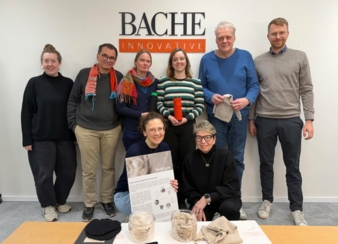
According to Hochschule Niederrhein, the FTB team visited Bache, where new knitted yarns had been developed as part of “KnitCycle” that were said to consist of up to 100% recycled material and could be processed again into high-quality textiles. © FTB
In cooperation with flat knitting specialist Bache, knitted yarns were developed that consist of up to 100 percent recycled material and can be processed again into high-quality textiles.
Worldwide, around 87 percent of textile waste currently ends up in landfill or is incinerated. At the same time, recycled material is often used only for low-grade applications. This is exactly where the project comes in: the aim was to improve the recyclability of knitted products already in the design and development phase – in the sense of “design for recycling”.
Focus on single components
The research focused, among other things, on material selection, product design and stitch constructions. In addition, key parameters of the mechanical recycling process were investigated, in particular using a tearing machine funded by the German Federal Environmental Foundation (DBU).
The project was supported by the associated partners Textechno H. Stein, who assisted with the analysis and evaluation of fibre quality, as well as Turns Faserkreisläufe, who contributed their expertise in the field of high-quality recycling. The results clearly show that decisions made during product development have a significant impact on the subsequent recyclability of textiles.
A central outcome of the project is the development of new knitted yarns made entirely from recycled fibres that nevertheless meet the requirements for high-quality textiles. This marks the first time it has been possible to largely close the material loop in the knitting sector.
Change brings new perspectives
Professor Ellen Bendt, who led the project at HSNR, was quoted as saying that the industry was facing a fundamental change: high-quality recycling was possible, but at present still significantly more expensive than producing virgin goods. This, she said, was exactly where innovation and a rethink across the entire value chain were needed.
New perspectives could emerge in particular for regional producers: production offcuts and textile waste could in future be recycled more efficiently and returned to the material loop. At the same time, the challenge remains to make recycling processes more economical and to establish them more broadly.
The insights gained in the project are now set to be further deepened in a follow-up project. Given limited resources, the repeated use of materials will play a central role for the textile industry in future.
About the “Knitcycle” project
The “Knitcycle” research project was carried out at the university’s own Research Institute for Textiles and Clothing (FTB) at Hochschule Niederrhein. It addressed innovative approaches to improving the recyclability of knitted products in the context of a sustainable circular economy. The German Federal Environmental Foundation (DBU) funded the project over two years with a total of around €290,000.