07/09/2026 – STFI and IWU Project — auf Deutsch lesen
Regional hemp bast for lightweight construction profiles
CannaPul: STFI and Fraunhofer IWU in Chemnitz are developing lightweight construction profiles from regional hemp bast. The focus is on continuous fibre strands, a thermoplastic matrix and a regional value chain.
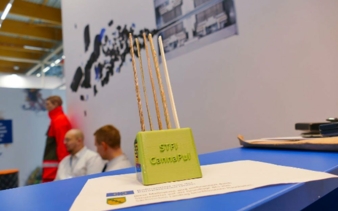
Heike Metschies, project manager at STFI, notes: “Initial results are already available in the form of rectangular profiles with hemp reinforcement and a thermoplastic matrix. We were able to present these at AGRA 26 in Leipzig to, among others, the Saxon Minister of State for the Environment and Agriculture, Georg-Ludwig von Breitenbuch, and to a large specialist audience at Techtextil in Frankfurt am Main.“ © STFI
Turning hemp bast into continuous reinforcement
The cultivation of fibre hemp for the production of ropes and clothing has a long tradition in Saxony. Due to its excellent fibre properties, it is also suitable as a renewable raw material for reinforcement in fibre composites. At the STFI and IWU in Chemnitz, the CannaPul project is currently investigating how a regional value chain for hemp-based lightweight construction profiles can be established. To this end, the technical processing of hemp fibres into continuous fibre strands and their embedding in a suitable bio-based matrix are being investigated.
The project partners in CannaPul are the Sächsisches Textilforschungsinstitut e.V. Chemnitz (STFI) and the Fraunhofer Institute for Machine Tools and Forming Technology IWU Chemnitz (IWU). The STFI is investigating the textile processing of high-strength hemp bast strips into continuous fibre strands and, as a result, is providing bio-based reinforcing fibres for the pultrusion process. The peeled hemp bast strips are separated by a fibrillation process and deposited evenly as a ribbon. The ribbon is stabilised against tensile stress through a coating process and made available as yarn.
Pultrusion targets, constraints and next steps
The central challenge in the CannaPul research project is the development and application of bio-based, regionally available materials. The aim is to produce continuous-fibre-reinforced profile structures from hemp bast fibres in combination with a bio-based thermoplastic matrix. A prerequisite for this is, on the one hand, the provision of suitable natural fibre strands from the renewable regional raw material hemp bast. On the other hand, the process requires the application of a thermoplastic biopolymer matrix with low viscosity and correspondingly high flowability, as well as a low melting temperature, to prevent thermal damage or burning of the hemp fibres.