17/06/2026 – Circular economy and robotics — auf Deutsch lesen
EU project FlexCycle recycles textiles
The focus is on autonomous systems with flexible end-effectors that can dismantle textiles, cables and fuel cells, recover precious-metal catalysts and route PFAS-based membranes back into a controlled material cycle using chemical processes.
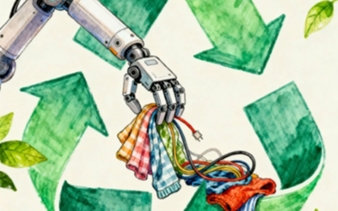
The new European research project “FlexCycle” focuses on the development of innovative robotics and AI solutions. © FlexCycle
Automated recycling of flexible materials
Flexible materials such as textiles, cables or fuel cell membranes are a particular challenge for automated recycling. Their soft, deformable structure is difficult to handle with conventional robots. This is where the European research project FlexCycle (Flexible Robotic Automation Techniques for Soft Materials Recycling) comes in. With a budget of 7.5 million euros and 12 partners from six countries, the consortium aims over the next four years to make recycling processes for flexible materials suitable for industrial application.
Textiles in automated recycling
In the textile use case, the focus is on clothing. The project partners train AI-based systems to identify flexible garments and handle them reliably. The systems are intended to detect features such as seams so that accessories including buttons and zips can be removed in a targeted way. In this way the fabric itself is recovered from the garments and made available for further processing.
Fuel cells and cables as additional use cases
Alongside textiles, FlexCycle addresses two further complex material structures. In the fuel cell use case, sensitive flexible membranes containing substances that are hazardous to health are in focus. Robots are designed to ensure safe extraction and to recover catalyst materials that contain precious metals. In the cable use case, the systems learn to work with tangled cable bundles. They must navigate through the wire mesh, isolate a target cable and then automatically remove insulating layers in order to recover metals such as copper efficiently.
Fraunhofer expertise and technological approach
Within the consortium, Fraunhofer IWKS concentrates on PEM fuel cells and uses its expertise to recover precious-metal catalysts such as platinum with high efficiency. Fraunhofer LBF focuses on the circular management of fluorinated PFAS membranes such as Nafion, a perfluorinated ionomer. The institute investigates processes including chemical dissolution in specialised solvent systems with subsequent recasting and depolymerisation. Technologically, FlexCycle combines flexible robotic tools as end-effectors with AI-based modelling and develops demonstrators that will validate the practical suitability of the autonomous systems in all three application fields.