08/09/2026 – Mechanical Textile Recycling — auf Deutsch lesen
Fibre Quality Is Determined in the Opening Process
Agatex has developed and industrially validated PFAS-free processing aids that reduce short fibres and dust while improving fibre length, carding performance and spinnability.
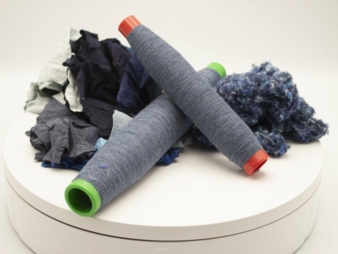
© Agatex Feinchemie
The Bottleneck Lies in the Opening Process
Mechanical recycling is considered the fastest route to industrially scaling the recovery of textile waste into the material cycle. Its central problem is physical in nature: during tearing, the textile is broken down through fibre-to-fibre and fibre-to-metal friction. The result is shorter fibres, a higher proportion of short fibres and dust. These three factors determine whether a recyclate can be processed on the card – and to what extent it can be blended with virgin material. Public debate on the circular economy focuses primarily on sorting, collection and logistics. The opening process itself, however, is often treated as a given. Yet this is where the available fibre quality is determined.
Developed, Validated and Implemented on an Industrial Scale
Based on these findings, Agatex has developed its own range of processing aids for the tearing process. For validation, it was essential to demonstrate the effect not merely at laboratory scale, but across the entire processing chain. To this end, the company is working in partnership with the Recycling Atelier of ITA Augsburg. The Recycling Atelier replicates the mechanical recycling chain on an industrial-scale basis – from preparation and the tearing process through to web formation and yarn production. This made it possible to assess what effect a processing aid has in the tearing machine and how much of that effect is actually carried through to the downstream stages. An effect that can be detected in fibre-length measurements but no longer has any impact in carding is of no practical value to the processor. The validated formulations are now being used in industrial applications.
Measurement Results
A tearing aid from the range was tested against an untreated reference:
Parameter I Change compared with reference
Mean fibre length +11.5%
Short-fibre content -10%
Dust generation -57.6%
The last two figures are particularly relevant for further processing. A lower short-fibre content improves fibre control in the card and therefore the evenness of the web. Less dust means fewer deposits on the card clothing and in the extraction system, longer cleaning intervals and more stable line performance. The reduction in dust is also relevant from an occupational hygiene perspective – an aspect that has so far received too little attention in discussions about increasing recyclate content.
The Effect Extends Beyond the Tearing Machine
For practical applications, it is crucial that the effect is not limited to the opening process. The treated fibre carries its modified surface properties into the downstream stages, where the benefits are in some cases even more pronounced than during the tearing process itself. In carding, reduced friction produces a visibly more uniform carding web. Fibre passage becomes smoother, while the tendency to form laps and fibre accumulation on the card clothing is reduced. Less dust in the system also means fewer contaminants in the web. In spinning, this results in improved and faster spinnability: the material can be drafted more consistently, allowing higher delivery speeds without compromising process reliability. For processors seeking to increase the proportion of recyclate, this is often the decisive factor – not the fibre length recorded in a test report, but whether the line can process the material cleanly and at the desired speed.
LAMBAFIL R – A Range Designed Around the Process
The development work has resulted in the Lambafil R range. It is not designed as a single-product solution: because friction behaviour varies significantly depending on the fibre type, the range is differentiated according to the composition of the incoming material stream and tailored to the relevant process step.
Lambafil R100 – for synthetic-rich recycled materials
Lambafil R200 – for cotton and cellulosic recycled materials
Lambafil R300 – for PET-rich recycled materials
Lambafil R400 – for PET/cotton blends
All products in the range are formulated without PFAS. The specific configuration is application-dependent: the composition of the incoming material stream, the machine setup and the target quality of the recyclate determine the product selection, application point and application rate.
Agatex Feinchemie GmbH will be exhibiting at Dornbirn GFC 2026.